How Volubile's “smart switchboard” works: a scalable voice-based conversational infrastructure
At Volubile, we don't just develop “talking AI.” We design a distributed voice-based conversational infrastructure capable of handling human calls in real time, with robustness, scalability, supervision, and business integration. Our goal is clear: to enable companies to never miss a call again, while automating simple, repetitive, and costly interactions.
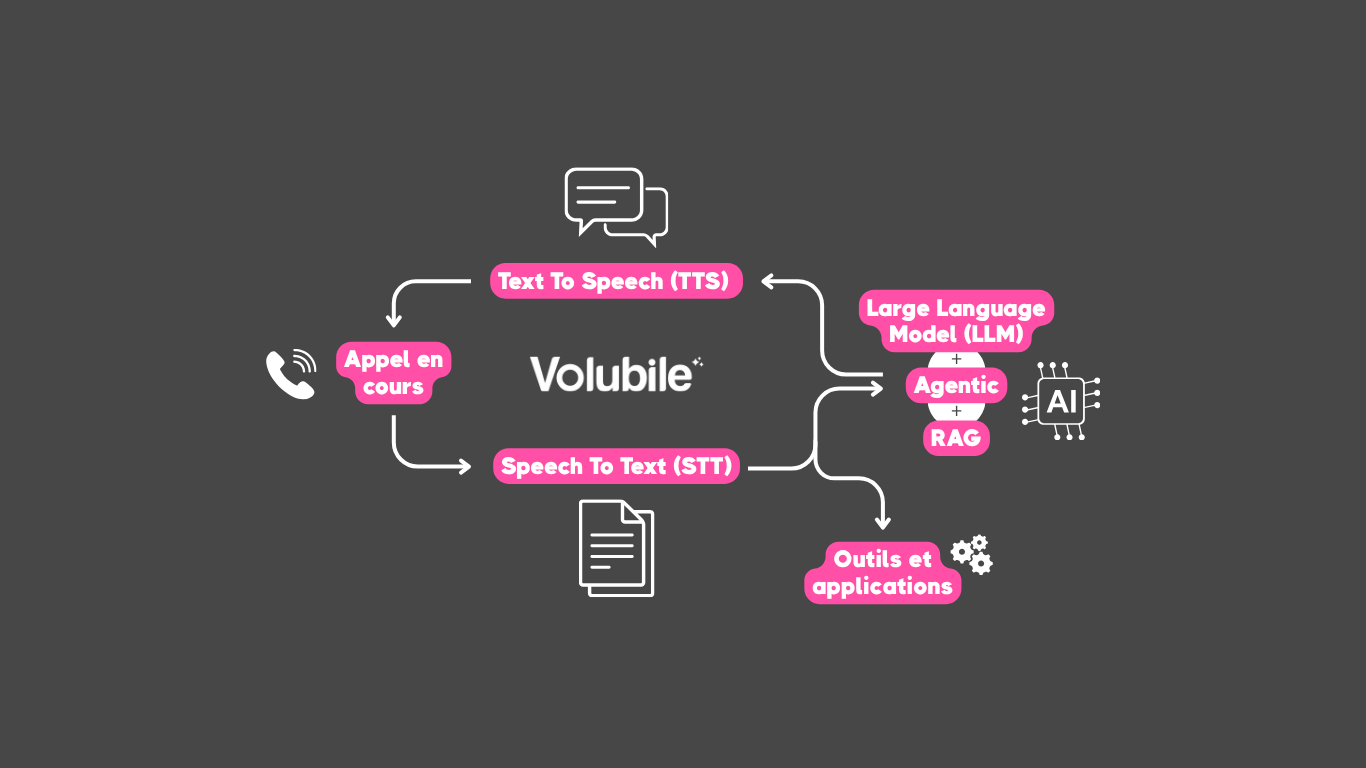
A technical architecture based on four fundamental building blocks
The technological core of Volubile is based on the orchestration of four key components:
- Speech recognition (STT): conversion of audio signals into text, using engines such as Azure, Deepgram, etc.
- Language model (LLM): interpretation of intent and generation of responses, using the best models on the market (GPT, Gemini, Claude, etc.), enriched by an agentic approach (state management, business logic) and a RAG architecture (injection of business context from vector databases).
- Text-to-speech (TTS): reproduction of the response in a natural voice, with a multilingual panel of voices selected from the best providers (ElevenLabs, Azure, Cartesia, etc.), configured to optimize prosody, rhythm, and expressiveness.
- Scalable telephony: call orchestration, routing, and supervision, with the capacity to manage thousands of simultaneous conversations and hundreds of thousands of calls per day, both incoming and outgoing.
These building blocks are orchestrated by a proprietary conversational core, designed to guarantee a fluid, reliable, and industrializable experience.
Recognize, understand, respond, call
1. STT (Speech-to-Text)
The engine is selected automatically according to the customer's business context.
The goal: to maximize accuracy in real-world environments (noise, accents, telephone quality).
2. LLM + Agentic + RAG
Volubile relies on commercially available LLMs, enhanced by:
- an agentic approach: conversational state management, dynamic adaptation, business logic,
- a RAG architecture: injection of business context from internal or customer vector databases.
This combination reduces hallucinations, adapts responses to the business, and manages complex conversations.
3. TTS (Text-to-Speech)
Volubile offers a range of multilingual voices, selected for their expressiveness and clarity. Each voice is configured according to the use case: tone, rhythm, prosody, language.
4. Scalable telephony
Volubile includes an orchestrator capable of:
- planning campaigns,
- dynamically routing calls,
- monitoring performance in real time.
Latency: an engineering challenge
Latency is the main factor in naturalness.
Volubile is designed to respond in less than 800 ms, thanks to:
- audio streaming from the first syllable,
- pre-generation of frequent responses,
- anticipatory speech synthesis,
- optimization of cloud infrastructure (horizontal scaling, semantic cache, fast embeddings).
Supervision, security, compliance
Volubile is hosted in Europe, GDPR compliant, with encrypted data flows and anonymization. Each call is analyzed in real time:
- reasons for calling,
- redirections,
- immediate satisfaction.
The “smart switchboard”: the first step
Most companies start with a simple need: “I want someone to answer the phone, even when my teams are not there.”
This is the role of the smart switchboard:
- Answer 100% of calls instantly.
- Understand the request.
- Provide information, handle the request, transfer the call, or schedule a callback.
- Automatically record the reason for the call in the CRM or calendar.
This first use case can be deployed in a matter of days and solves the number one problem: never missing a call.
It then serves as a foundation for automating:
- prospecting,
- follow-ups,
- order tracking,
- incident management.
What sets Volubile apart from American platforms
American platforms such as Bland, Vapi, and Retell are designed for developers. They offer a modular approach: choose your STT engine, TTS, LLM, write your prompt, configure API calls, host models.
This flexibility is powerful, but it involves:
- high technical complexity,
- risks of latency,
- significant operational responsibility.
Volubile takes a different approach. We are an business platform, with a qualified, supported, and supervised approach.
- Supported deployment: structured onboarding, business configuration, continuous supervision.
- Operated infrastructure: cloud orchestration, scalability, monitoring.
- Business performance: agents optimized for real use cases, not for experiments.
Volubile manages thousands of simultaneous conversations, hundreds of thousands of calls per day, and integrates natively with your business tools.
This is what makes Volubile a conversational infrastructure, not a technical toolbox.